
Zombies Arent Real Zombie Spread, Explained
How infection spreads in Zombies Arent Real: purple buildings, civilian conversion, zombie health scaling and why the horde count is not the number to watch.
The horde in Zombies Arent Real does not spawn from the edge of the map. It grows out of the city: infected blocks turn, civilians inside them turn, and the number in the corner of the screen climbs while you watch.
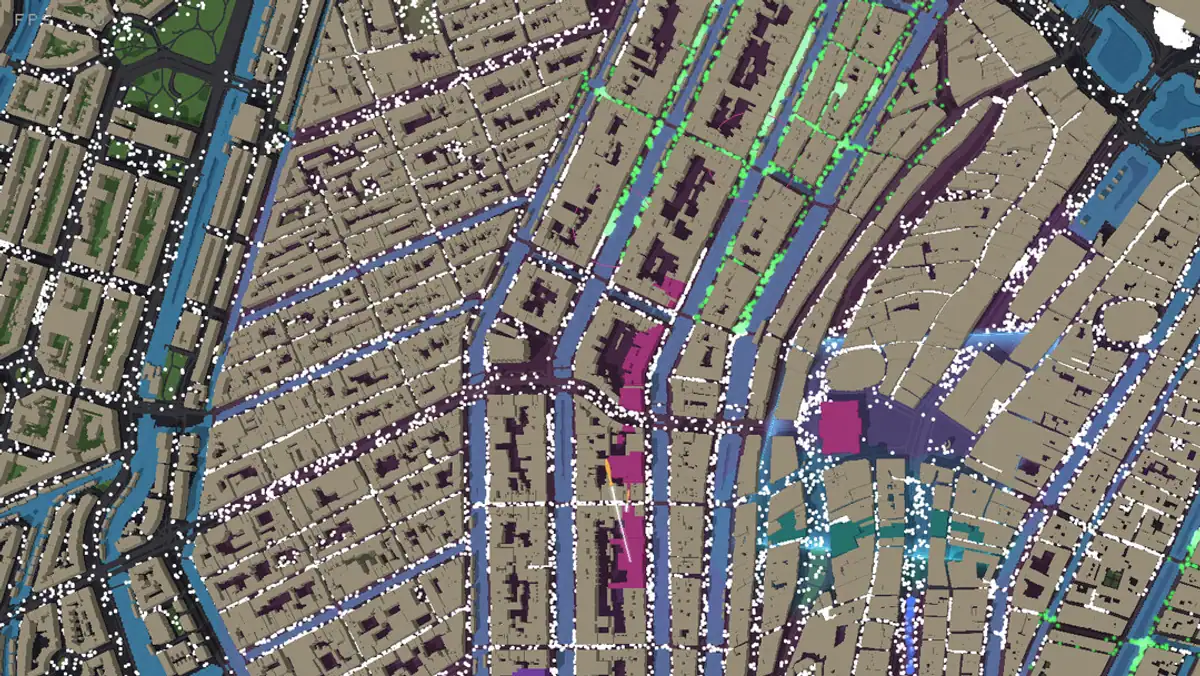
That is why the purple blocks on the map matter more than the zombies you can see. They are the source, and the source is always inside the city you are trying to save.

What you can actually see
The launch build's map view distinguishes three states:
| Marker | Meaning | What it does |
|---|---|---|
| Purple blocks | Infected buildings | Produce zombies and spread infection |
| Grey blocks | Intact buildings | Can be infected if zombies reach them |
| Cyan outline | Safe zone | Your designated perimeter |
The stats overlay turns that into numbers: Zombies (a total that ran to 59,727 in one capture), Civilians Left (a percentage), and Zombie Health (2 on one map, 4 on another).
Three numbers, and only one of them is really about the horde.
The count is not the threat
Fifty-nine thousand zombies is not a number you can fight. It is a number that tells you how much of the city has already turned. Watch it the way you would watch a fire alarm: it tells you how bad it is, not what to do about it.
What you can act on:
- Where the purple is moving. Infection spreads from building to building, so the direction matters more than the total.
- Which routes it is about to reach. A block that turns behind your corridor is worse than a block that turns in front of it.
- How much civilian population sits in its path. The banner measures saved civilians, and civilians in the path of the spread are on a timer.
Civilians are the fuel
The store description is direct about it: infection spreads through the population, and the people you are supposed to save are also what feeds the horde. Every civilian district that falls adds to the count.
That produces a hard prioritisation rule: save the civilians nearest the infection first if the infection is growing, and save the civilians nearest the exit first if it is not. The first rule is about slowing the growth; the second is about the score.
Most runs need both, in that order, which is why a corridor that branches once beats a corridor that runs straight through the middle.
Zombie health is the difficulty dial
Zombie Health is the number that will break your layout. At health 2, a sniper removes bodies quickly and garrisons hold easily. At health 4, the same sniper needs twice as many shots and the same garrison dies twice as fast.
That is the reason a tier list for this game has to be a snapshot. Every cheap strategy is a bet on low health, and the game raises health as you progress. When it does, the answer is not more of the same unit; it is more damage concentration and better funnels.
Slowing the spread
You cannot stop the infection, but you can slow what it reaches:
Hold the routes, not the buildings. Zombies moving through a street are zombies not yet inside a building. A chokepoint keeps the spread on the wrong side of a wall.
Keep corridors off the infection front. A civilian route that touches the purple is a route that delivers fuel.
Use the walls as a firewall. A wall does not stop infection in the abstract, but it does stop the zombies that carry it, and that is the same thing in practice.
Do not chase the count. Killing fifty thousand zombies is not a plan; holding a corridor while four hundred civilians leave is.
The read that matters
Before the first wave, look at the map and answer one question: where will the infection reach in the next five minutes, and what is in that area?
If the answer is a civilian district, your layout is wrong regardless of how many units you bought. If the answer is empty blocks you have already given up, your layout is ahead of the game.
That is the entire strategic layer of Zombies Arent Real, and it is why the chokepoint guide → and the civilian guide → are the two pages worth reading twice.
A rising zombie count looks like a combat problem and is usually a civilian problem. If the count is climbing while your kill column is healthy, the infection is eating districts you are not defending.
Official source: Steam store page ↗ · Steam Community hub ↗ · SteamDB ↗
FAQ
How does infection spread in Zombies Arent Real?
Infected buildings turn, and the population inside them joins the horde. The purple blocks on the map show where it already is, and the zombie count grows as it reaches more of the city.
Can I stop the spread completely?
Not in the launch build. The playable goal is to slow it and evacuate civilians, not to sterilise the city.
What does zombie health mean?
It is a difficulty multiplier shown in the stats overlay: a value of 2 or 4 in the launch captures. Higher values mean the same units need more shots to kill the same zombies.
Why is the zombie count so high?
Because it counts the converted population of an entire city, not a wave. Treat it as an indicator of how much has already fallen rather than a target.
Do infected buildings produce zombies forever?
They keep producing while the infection holds them, which is why regaining ground matters less than preventing the spread from reaching civilian districts.