
How to Play Zombies Arent Real: The Loop
The full Zombies Arent Real loop: planning phase, deploy bar, safe zones, civilians and the 10% win condition, explained in the order the game asks for them.
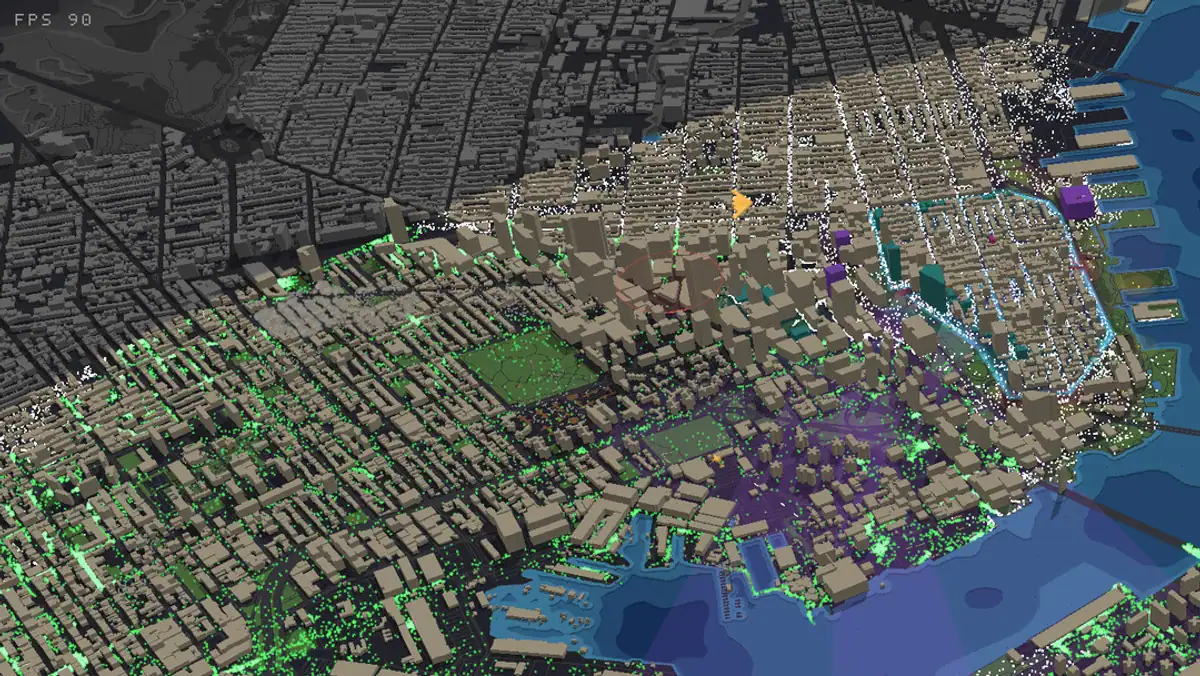
Zombies Arent Real is a horde-defense strategy game built on real-world city maps. That sentence covers a lot: you get a planning phase, a fixed budget, ground units, air support, a civilian population that keeps shrinking, and a horde that spreads through buildings rather than marching down a lane.
This page is the loop, in the order the game actually asks for it. If you want the first-mission walkthrough instead, start with the beginner guide →.

Step one: the planning phase
Every mission opens with the infection already established and the clock not yet running. You can pan, zoom, inspect buildings, and place units with no pressure at all. Nothing attacks during this phase.
The planning phase is where a run is won or lost, because it is the only moment when you can see the whole board without the board moving. Use it to find three things: the purple infected blocks, the civilian concentrations, and the routes between them.
The map is a real city, so it behaves like one. Rivers cut the board into islands. Bridges become mandatory crossings. Wide arterial roads are fast for zombies and slow for your line of fire. Dense residential blocks offer garrison cover but hide the horde until it is close.
Step two: the budget
You do not get income during a mission. What you get is a starting budget and a refund button. That means the economy is a one-time allocation problem, not a growth curve.
The launch build's deploy prices:
| Category | Item | Price |
|---|---|---|
| Ground | Garrison | $15+ (scales) |
| Ground | Sniper | $35 |
| Ground | Turret | $90 |
| Ground | Mortar | $270 |
| Traps | Spikes | $1.00 |
| Traps | Mine Field | $200 |
| Explosives | C4 | $500 |
| Civilians | Corridor | $0.40 per length |
| Civilians | Hold | $0.80 per radius |
| Build | Safe Zone | $1.00 per cell |
| Build | Wall / Fortify / Gate | free placement tools |
Two things about that table are more important than the numbers. First, the cheap tier is genuinely cheap: spikes and safe-zone cells cost about a dollar, so perimeter work is a rounding error next to a mortar. Second, one expensive item is usually better than three mid-priced ones, because your attention scales worse than your money.
Step three: deploy ground units
Ground units are the ones that stay where you put them.
Garrisons put infantry inside a building. They are the only unit whose price rises as you buy, which tells you the designers expect you to spam a few early and then stop. A garrison holds a doorway and dies slowly; it does not clear a street.
Snipers are single-target specialists at long range. At $35 they are the cheapest way to convert a rooftop into a threat, and they are the reason you should not cluster all your units on one sightline.
Turrets trade flexibility for rate of fire. Put one where the geometry forces a single approach and it will pay for itself. Put one in the open and it will shoot at whatever wanders past while the real push goes elsewhere.
Mortars are the area answer: 40 m blast, 160-630 m range, a four-round magazine and a 20 second reload. The selected-unit panel shows Lv2: 3x Fire Rate, Reload, so a $150 upgrade turns a slow support unit into a sustained one.
Step four: use air support
Air support is on the ability bar during the fight: Paratroopers, Strike, Missile, Gas, Heli and APC. These are limited-use calls, not purchases, and the counts on the bar are what you have left.
The store page is explicit that air support can kill civilians. That is the trade: a strike clears a block and takes the people in it with it. Gas and missiles are area tools with the same problem. Helicopters are the highest-kill unit in the stats overlay when used well, but they are also the fastest way to turn a winning run into a 2% banner.
Air support is covered in detail in the air support guide →.
Step five: move civilians
Civilians are the mission. The banner at the top of the deployment UI reads CIVILIANS SAFE: 2% - NEED 10%, and the game scores survivors, not kills.
You influence civilians in three ways:
- Corridor draws a path for them at $0.40 per length. Cheap, and the only direct way to tell them where to go.
- Hold ($0.80 per radius) tells people in an area to stay put, which is useful when the route is not ready yet.
- Safe Zone marks cells where units resupply — the mortar panel annotates its unlimited reloads with
Inside Safe Zone— and where civilians can be sheltered.
A corridor that leads into a defended street is worth more than a perfectly held district with no exit. That single idea fixes most losing runs, and the Steam Community hub ↗ is where players post the layouts that went wrong, which is often more instructive than a clean win screenshot.
The selected-unit panel annotates a unit's unlimited reloads with Inside Safe Zone. Treat the zone as your resupply footprint: units outside it will eventually run dry.
Step six: hold, adjust, win
Once the horde moves, the game becomes maintenance. Pause with [Spc], change speed with the 1/2x to 8x controls, watch the stats overlay, and move what is not working.
The overlay gives you four numbers worth reading:
| Readout | What it tells you |
|---|---|
| Civilians Left | How much of the population is still on the board |
| Zombies | Current horde size, which spikes as infection spreads |
| Zombie Health | Difficulty scaling between missions |
| Kills Per Unit Total | Which of your purchases is actually killing |
If a unit sits at 0.0 kills while another climbs, refund it and buy something the map needs. That is not a failure state; it is the intended verb.
Official source: Steam store page ↗ · Steam Community hub ↗ · SteamDB ↗
FAQ
How long is a mission in Zombies Arent Real?
Missions are short sessions rather than campaigns. The planning phase is untimed, the fight runs at a speed you control, and a run ends when the horde is cleared or the civilian count settles below the pass mark.
Can I pause in the middle of a fight?
Yes. The pause control is on the speed widget in the corner of the screen, and the deployment UI stays usable while paused. Pausing to reposition a mortar is normal play, not an exploit.
Is there an economy during the fight?
No income arrives mid-mission. Your spending power is the starting budget plus whatever refunds you take, which is why the planning phase matters more than the trigger discipline.
Does the game have a story campaign?
The launch build is an Early Access strategy sandbox over real city maps, with missions, difficulty options and online co-op for two players. The store page describes the loop rather than a narrative campaign.
What happens if I save fewer than 10% of civilians?
The mission reads as failed even if your kill count is high. The horde counts as cleared only when there is nothing left walking, so the civilian threshold is the actual objective and the kill count is the style score.