
Zombies Arent Real Mortar: The Full Stat Sheet
The Zombies Arent Real mortar explained with its real panel numbers: 40 m blast, 160-630 m range, 4-round magazine, 20 s reload and the $150 level two.
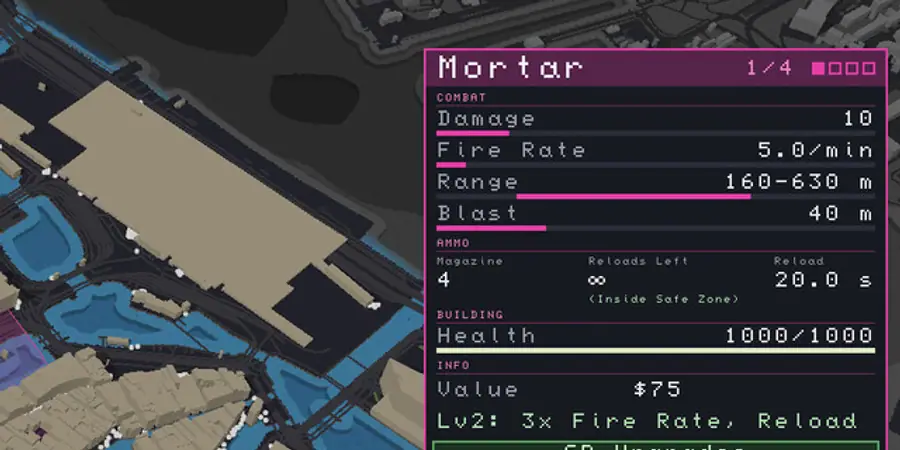
The mortar is the only unit in the launch build that shows a full stat sheet, which makes it the only unit you can argue about with numbers instead of vibes. Select one and the panel reads like a spec card: damage, fire rate, range band, blast radius, magazine, reload, health, value, and the level two bonus.
That panel is also where the mortar's problem becomes visible. Every number on it is built for a unit that stands still and shoots slowly at something far away.
The stat sheet
| Stat | Value | What it means in practice |
|---|---|---|
| Damage | 10 | Per shell; the blast does the work, not the direct hit |
| Fire Rate | 5.0/min | One round every twelve seconds |
| Range | 160-630 m | A band, not a radius: close targets are outside it |
| Blast | 40 m | Hits clumps; friendly to nothing inside the circle |
| Magazine | 4 | Four shells, then a long silence |
| Reloads Left | Unlimited, inside a safe zone | Resupply depends on your build footprint |
| Reload | 20.0 s | The reason the magazine size matters |
| Health | 1000 | Tougher than it looks; it is not a glass cannon |
| Value | $75 on the panel | The bar charges $270; use the bar for budgeting |
| Lv2 | 3x fire rate, reload | The upgrade is entirely about downtime |
Two of those lines are the whole unit. The range band means the mortar cannot defend itself: anything that walks inside 160 m is in a blind spot. The reload means it cannot defend a street on its own either, because twenty seconds is long enough for a horde to cross a block.
What the mortar is for
Area denial at distance. The mortar is the unit that hits the second wave before it becomes the first wave, and the only ground unit that ignores line of sight.
That makes it good at three jobs:
Breaking up a clump. The 40 m blast means a tight group takes damage several times over. On open waterfront or a wide plaza, that is exactly the shape a horde forms.
Covering ground you cannot see. A mortar behind a building can hit the street on the far side. No other ground unit does that.
Punishing a static push. When the horde masses at a wall, the mortar is the answer that does not require the wall to hold forever.
And it is bad at three jobs: close defense, fast response, and anything that requires killing a single high-health target before it arrives.
The minimum range is the whole weakness
The 160 m floor is not a rounding error. It defines a ring around the mortar that the mortar cannot touch. If a zombie gets inside that ring, you need something else: a garrison at $15, a sniper at $35, spikes at a dollar, or a wall with a gate.
This is why mortar placements fail. New players put the mortar where it can see the fight, which is usually too close, and then discover that the fight it can see is outside its band while the fight that matters is inside it. Put the mortar further back than feels right, and put cheap bodies in the ring it cannot cover.
Level two, and why $150 changes the unit
The panel lists Lv2: 3x Fire Rate, Reload, and the level-up button sits right next to refund at $150. Three times the fire rate on a 5.0/min weapon is the difference between supporting a defense and being one.
The math is unglamorous but decisive. At 5.0 rounds per minute with a four-round magazine, the mortar fires for about forty-eight seconds and then spends twenty seconds silent. Triple the rate and the same magazine empties in sixteen seconds, which is worse, which is why the same upgrade also shortens the reload. The result is a weapon that cycles instead of pausing.
Spend the $150 when the mortar is already earning kills. Upgrading a mortar with 0.0 kills buys you a faster way to miss.
Where to put it
Three placements that work, in order of reliability:
- Behind the civilian corridor, elevated if the map allows. The mortar covers the approach to the corridor without standing in it.
- On the flank of a chokepoint, not on the chokepoint. The bridge itself should be held by a turret or garrisons; the mortar covers the queue behind the bridge.
- Anywhere with a safe-zone cell under it. The panel's unlimited reloads are annotated
Inside Safe Zone, so the mortar wants to be inside your supply footprint or it will run dry.
That last point connects the mortar to the safe zone guide → more than to any damage theory. A mortar outside the zone is a four-shell unit.
Verdict
The mortar is a B-tier purchase that becomes A-tier under two conditions: the map has open ground where clumps form, and you have already paid for the units that cover its minimum range.
Buy it second, never first. Buy it where the horde masses, not where you are looking. Upgrade it only after it has kills, and check the Steam Community hub ↗ after patches, because a change to that 160 m floor would change the whole unit.
The panel says $75 and the bar says $270 in the same build. Until that is fixed, assume $270 and treat any cheaper figure as a display bug rather than a discount.
Official source: Steam store page ↗ · Steam Community hub ↗ · SteamDB ↗
FAQ
How much damage does the mortar do?
Ten per shell according to the selected-unit panel, with a 40 m blast radius doing the actual work against groups.
What is the mortar's range?
160 to 630 m. It is a band with a hard minimum, so targets closer than 160 m cannot be engaged at all.
Is the mortar worth $270?
On open maps with clumped hordes, yes. On tight streets where everything arrives inside its minimum range, a $90 turret plus garrisons does the job for less.
How long is the mortar reload?
Twenty seconds for a four-round magazine at 5.0 rounds per minute. Level two triples the fire rate and shortens the reload, which is the main reason to spend the $150.
Why does the panel show a different price?
The launch build's panel displayed a value of $75 while the deploy bar charged $270. Treat the bar as authoritative and expect the inconsistency to be cleaned up during Early Access.